Mythical Creatures Symbolism Explained Clearly
A dragon on a shirt is never just a dragon. It may signal untamed force, vigilance, greed, wisdom, imperial authority, or the difficult work of mastering one’s own destructive instincts. That is the real value of mythical creatures symbolism explained well: it turns familiar imagery into a language of character.
Mythical beings endure because they make invisible struggles visible. Fear becomes a monster. Renewal gains wings and rises from ash. Instinct takes the form of a wolf at the edge of the firelight. These figures were not created as decoration. They gave ancient people a way to confront power, disorder, mortality, temptation, and courage.
For anyone drawn to meaningful designs, the question is not simply which creature looks strongest. It is what the creature asks of you.
Why Mythical Creatures Still Carry Weight
A mythic creature is often an archetype rather than a single fixed idea. Its meaning changes between cultures, eras, and stories. A serpent can represent deception in one tradition and healing, protection, or sacred renewal in another. A dragon may be a tyrant to defeat, a guardian of hidden knowledge, or an emblem of rightful power.
That ambiguity is not a flaw. It is why these symbols have lasted. Real strength is rarely simple. Discipline can become rigidity. Ambition can become greed. Independence can become isolation. Mythic creatures hold both sides of the struggle in one memorable form.
They also make personal ideals visible. A man may wear a wolf not because he believes himself feral or solitary, but because he respects loyalty, alertness, endurance, and the ability to move through difficulty without losing direction. Symbolic graphic tees work when the image has that second layer. The artwork becomes a quiet statement of what matters.
Mythical Creatures Symbolism Explained: The Major Archetypes
The Dragon: Power That Must Be Governed
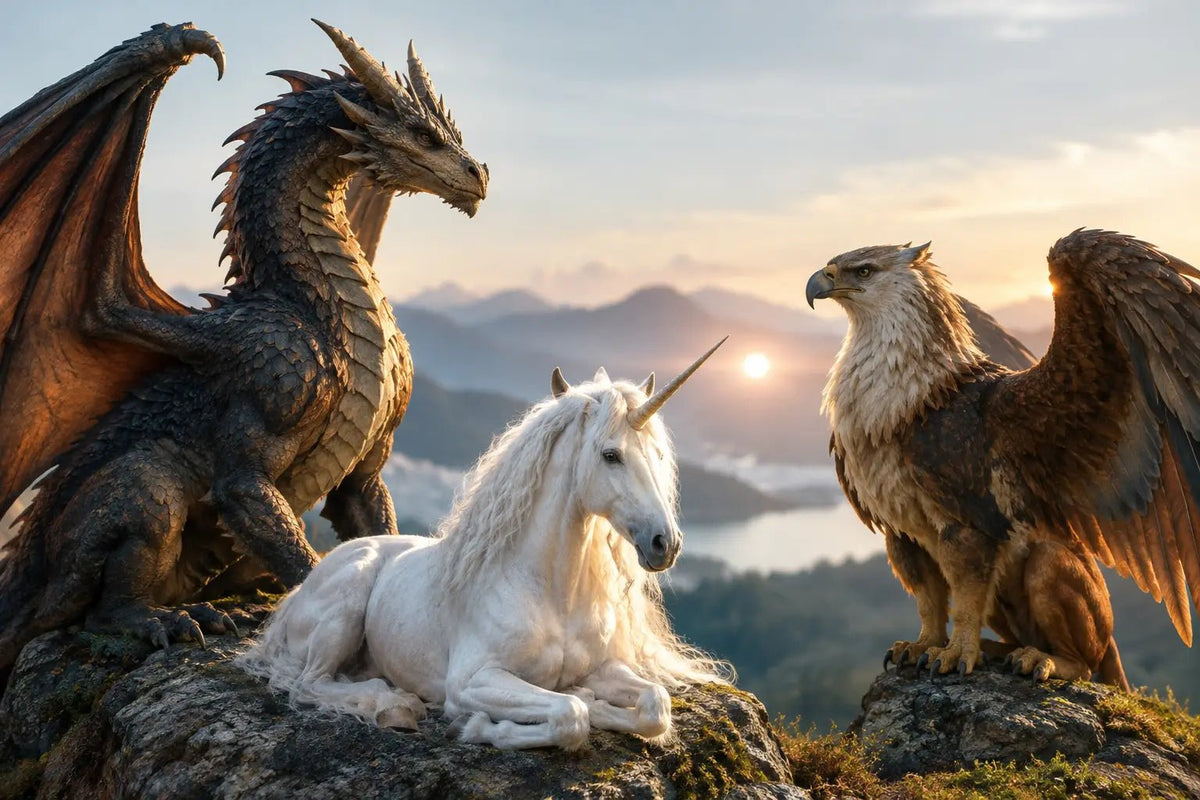
Few symbols carry more force than the dragon. In many European legends, dragons guard treasure, devastate kingdoms, and stand as obstacles before the hero. They are appetite without restraint: hoarding, rage, domination, and the chaos that follows when power answers to nothing.
Yet dragons are not only enemies. In East Asian traditions, they are frequently connected to rain, fertility, wisdom, heavenly order, and benevolent authority. The contrast matters. The dragon is not inherently evil or noble. It represents immense power. What changes is the hand, mind, or moral order directing it.
As a personal symbol, the dragon suits those who understand that strength without discipline becomes self-defeat. It is a reminder to build force, then learn to command it.
The Phoenix: Renewal Earned Through Fire
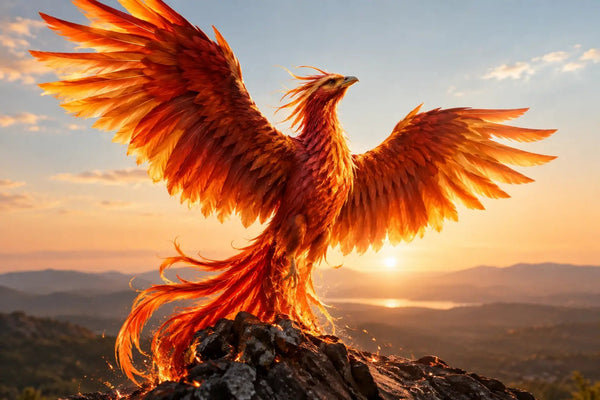
The phoenix is often reduced to a motivational slogan about starting over. Its older meaning is harder and more useful. Renewal requires an ending. The bird does not simply improve itself. It is consumed, and from that destruction new life emerges.
This makes the phoenix a fitting emblem for recovery after failure, loss, or a season that stripped away an old identity. Its symbolism is not about pretending hardship never happened. The ashes remain part of the story. What matters is the decision to rise with greater clarity.
For resilience, few images are more direct. The phoenix does not promise an easy path. It honors the man who rebuilds after the collapse.
The Griffin: Courage Joined to Judgment
The griffin combines the lion, king of beasts, with the eagle, ruler of the sky. Lion strength meets eagle vision. In ancient and medieval art, griffins were often guardians of treasure, sacred spaces, and royal authority.
Its lesson is balance. Courage without perspective can be reckless. Intelligence without courage can become hesitation. The griffin represents the rare union of both: the ability to see clearly and act decisively.
That makes it an especially strong symbol for leadership. Not loud authority, but watchful authority. The kind that protects what is valuable and does not need to prove itself through noise.
The Serpent: Danger, Knowledge, and Transformation
The serpent is one of the oldest and most complex symbols in human history. Its shedding skin made it an emblem of renewal. Its movement close to the earth connected it to hidden knowledge, the underworld, and primal life. Its venom made it both feared and respected.
In Greek symbolism, the serpent appears around the staff of Asclepius, associated with healing and medicine. The ouroboros, a serpent consuming its own tail, represents cycles, eternity, and the unity of destruction and creation. Elsewhere, serpents become tempters or forces of chaos.
A serpent design should not be read as a simple badge of rebellion. It can stand for adaptation, hard-won knowledge, and the ability to change form without abandoning one’s core.
The Wolf: Instinct Under Oath
The wolf occupies a place between the wild and the social. Wolves are associated with endurance, hunting skill, alertness, family structure, and fierce defense of the pack. In Roman tradition, the she-wolf that nursed Romulus and Remus became tied to the founding of Rome itself.
But the wolf is not a universal symbol of noble independence. In Norse myth, Fenrir is a terrifying force of destruction, while other wolf figures may guide, hunt, or threaten. The meaning depends on the story.
For modern symbolism, the wolf is strongest when it represents loyal instinct rather than empty isolation. The disciplined wolf knows when to stand alone and when to protect his people.
The Kraken: Respect for What You Cannot Control
The kraken, born from Nordic seafaring lore, embodies the terror of deep water and the limits of human command. Sailors faced storms, darkness, strange currents, and a sea that could destroy skill and confidence in a single hour. The monster gave that uncertainty a body.
Its meaning is not merely fear. The kraken reminds us that competence does not make us invulnerable. There are forces larger than individual will: nature, time, chance, and consequence. Respecting those forces is not weakness. It is wisdom.
In a culture that celebrates total control, the kraken offers a sterner principle: prepare fully, remain calm, and never confuse courage with arrogance.
Context Matters More Than the Creature
A creature’s meaning comes from its culture, its story, and its visual treatment. A dragon coiled around gold says something different from a dragon ascending through clouds. A phoenix rendered in bright flames can feel triumphant; one shown among ash and broken stone carries a more reflective weight.
This is why symbols should be chosen with care. Borrowing imagery without understanding can flatten living traditions into generic aesthetics. The better approach is to learn the source, acknowledge that meanings vary, and choose the aspect of the creature that honestly fits your values.
The same principle applies to apparel. Meaningful design does not require a lecture printed across the chest. A well-composed creature, a historical reference, and purposeful details can communicate more than a slogan. Hilt & Stone approaches mythic imagery as wearable symbolism: artwork built to carry conviction without becoming costume.
Choosing a Creature That Means Something
Start with the challenge you are actually facing. If you are rebuilding after a difficult chapter, the phoenix may speak clearly. If your work demands calm authority, the griffin offers a stronger message than brute force. If you are learning to govern anger, ambition, or appetite, the dragon has more depth than a generic symbol of dominance.
Then consider the shadow side. Every worthwhile symbol contains a warning. The wolf can become isolation. The serpent can become cunning without conscience. The phoenix can become an excuse to romanticize destruction. The dragon can become ego. Wearing the symbol with awareness is what separates an archetype from an accessory.
The best mythical creature is not the one that makes you look invincible. It is the one that reminds you what must be trained, defended, endured, or renewed when no one is watching.