12 Best Philosophical Quotes on Resilience
A hard season reveals whether an idea is decoration or equipment. The best philosophical quotes on resilience have endured because they do more than make hardship sound noble. They give hardship a shape: something to meet with discipline, clarity, courage, and a refusal to surrender command of the self.
The ancient world did not romanticize pain. Stoics lived through exile, illness, political violence, and personal loss. Greek thinkers examined courage as a practiced virtue, not an inherited personality trait. Later philosophers asked what remains when certainty, comfort, and control are stripped away. Their answers are not always gentle. That is why they remain useful.
What makes a resilience quote worth keeping?
A real philosophical quote should not promise that suffering will make you stronger by default. It will not. Some hardship wounds, some narrows a life, and some requires help, rest, or a change of course. Resilience is not denial. It is the capacity to respond without abandoning your values or your agency.
The strongest lines below are not commands to feel nothing. They are reminders to distinguish what can be changed from what must be borne, to train before pressure arrives, and to make character visible through action.
12 best philosophical quotes on resilience
1. Marcus Aurelius on the inner citadel
> “You have power over your mind - not outside events. Realize this, and you will find strength.”
Marcus Aurelius wrote Meditations while carrying the burden of empire, war, disease, and betrayal. His point is not that external events are unimportant. They can be devastating. His point is that your judgment, conduct, and next action still belong to you. Resilience begins where helplessness ends: at the border of your own choices.
2. Marcus Aurelius on the obstacle
> “The impediment to action advances action. What stands in the way becomes the way.”
This is one of Stoicism’s hardest ideas. The obstacle is not automatically good, but it can become material for virtue. A setback can demand patience. An insult can demand restraint. A failed plan can demand better preparation. The event does not grant meaning on its own. Your response gives it form.
3. Epictetus on reaction
> “It’s not what happens to you, but how you react to it that matters.”
This familiar wording is a concise modern rendering of Epictetus’s teaching. Born into slavery and later exiled, Epictetus understood constraint more intimately than most philosophers who speak about freedom. He argued that freedom is found in governing one’s judgments, desires, and choices, even when circumstances cannot be governed.
That distinction matters when resilience language becomes shallow. You cannot control every outcome. You can still refuse to let chaos decide who you become.
4. Epictetus on becoming deliberate
> “First say to yourself what you would be; and then do what you have to do.”
Identity is built under repetition. If you want to be steady, act steadily in small moments before the major test arrives. If you want to be courageous, practice telling the truth when the cost is modest. Epictetus does not offer a mood. He offers a standard, then asks you to live up to it.
5. Seneca on adversity
> “Difficulties strengthen the mind, as labor does the body.”
Seneca’s comparison is exact. Training only works when stress is measured. Too little resistance changes nothing; too much can break the athlete. The same is true of the mind. This quote is not permission to seek misery or dismiss another person’s pain. It is a call to use manageable hardship as training rather than treating every difficulty as a verdict on your life.
6. Seneca on courage
> “Sometimes even to live is an act of courage.”
There is no false grandeur in this line. Not every battle looks heroic from the outside. Getting up, keeping a promise, making the appointment, beginning again after disappointment - these can be acts of courage. Seneca understood that endurance is often quiet. It does not need an audience to be real.
7. Aristotle on practiced virtue
> “The brave man is he who faces and who fears the right thing and from the right motive.”
Aristotle refused to confuse courage with recklessness. Fear is not weakness. The question is whether fear is proportionate and whether action is guided by a worthy purpose. A man who feels no fear may simply fail to understand the danger. A courageous man sees the danger clearly and does what duty requires anyway.
8. Friedrich Nietzsche on hardship
> “That which does not kill us makes us stronger.”
Few philosophical lines are quoted more often, or more carelessly. Nietzsche’s sentence is not a medical or psychological law. Survival does not guarantee growth. But it names a possibility: a person can transform an ordeal into greater discernment, self-knowledge, and resolve. The work is in the transformation, not merely in enduring the blow.
9. Lao Tzu on self-command
> “He who conquers others is strong; he who conquers himself is mighty.”
The Tao Te Ching cuts against the usual image of strength. Dominating another person may display force, but governing appetite, temper, vanity, and fear displays something rarer. Self-command is not a dramatic conquest completed once. It is a daily discipline. That makes it more demanding than any public victory.
10. Miyamoto Musashi on useful action
> “Do nothing which is of no use.”
The swordsman and strategist Miyamoto Musashi wrote with a warrior’s economy. Read too literally, this can sound joyless. Rest, friendship, beauty, and play are useful to a whole life. The deeper lesson is to remove wasteful action born from distraction, ego, or impulse. Resilience depends on conserved energy. A scattered life has little reserve when pressure comes.
11. Viktor Frankl on adaptation
> “When we are no longer able to change a situation, we are challenged to change ourselves.”
Frankl’s words carry unusual weight because they emerged from his experience surviving Nazi concentration camps. They should never be used to minimize injustice or tell people to accept what must be resisted. Yet there are conditions no individual can immediately alter. In those moments, Frankl directs attention toward inner orientation, responsibility, and the meaning of one’s next act.
12. Albert Camus on the invincible core
> “In the depth of winter, I finally learned that within me there lay an invincible summer.”
Camus offers no easy optimism. His work confronts an indifferent world and the absurdity of expecting it to explain itself. The “invincible summer” is not cheerfulness. It is the part of a person that can still choose presence, solidarity, and defiance when circumstances are cold. Resilience, here, is a form of rebellion against despair.
Turn a quote into a discipline
A quote becomes weak when it is only saved, reposted, or printed without practice. Choose one line that exposes your current weakness. If you are anxious about outcomes, return to Marcus Aurelius and define the next action within your control. If you are distracted, take Musashi’s question into your schedule. If you avoid hard conversations, use Aristotle’s standard: what is the right thing to face, and what motive makes it worth facing?
Write the quote somewhere visible for a week. Then pair it with one concrete behavior. “I have power over my mind” might mean no phone for the first thirty minutes of the morning. “Conquer yourself” might mean keeping the training session you planned. Philosophy gains force when it enters the calendar, the body, and the decisions nobody applauds.
Symbols that carry the lesson forward
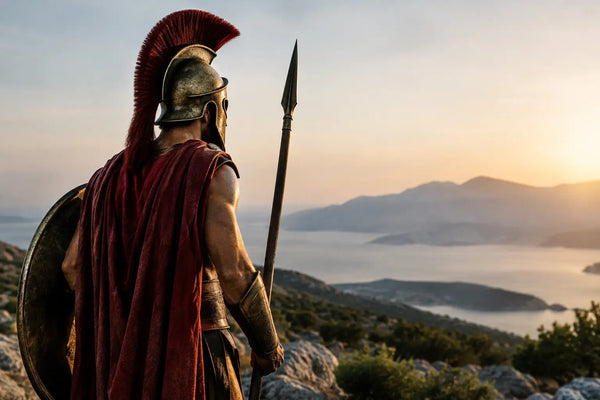
The old symbols of resilience remain compelling because they make an inner commitment visible. The Spartan helmet suggests duty under pressure. The laurel recalls earned endurance rather than empty status. The phoenix represents renewal, while the Stoic image of the inner citadel speaks to a mind that cannot be easily occupied by fear.
That is the difference between a graphic and a meaningful design. A philosophy T-shirt should carry an idea worth standing behind, not borrow ancient imagery as costume. Hilt & Stone approaches symbolic apparel as a modern standard of identity: purposeful artwork, quality craftsmanship, and principles made wearable.
Choose the quote that does not merely comfort you. Choose the one that asks more of you, then let your conduct give it weight.