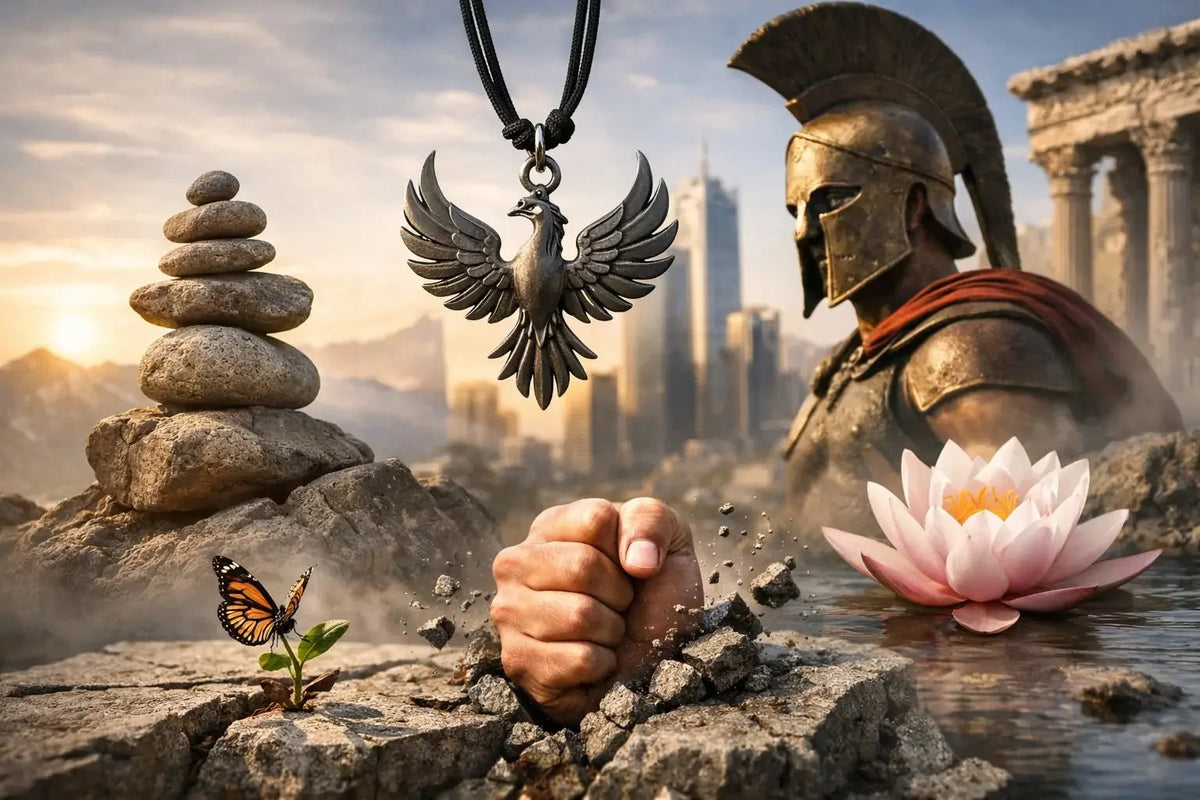
10 Best Symbols for Resilience and Inner Strength
A symbol cannot carry a burden for you. It can, however, remind you who carries it. The best symbols for resilience are not decorative shortcuts to strength. They are marks shaped by stories of trial, recovery, discipline, and the decision to continue when comfort is gone.
Across ancient cultures, resilience was rarely understood as passive toughness. It meant meeting hardship with character intact. A well-chosen emblem can become a private standard: something worn, carried, drawn, or kept in sight when the work becomes difficult.
What Makes a Symbol of Resilience Meaningful?
The strongest symbols have earned their meaning. They come from traditions, landscapes, and myths that have endured pressure without losing their essential form. Some represent rebirth after destruction. Others stand for rootedness, protection, or patient effort.
The right choice depends on the kind of resilience you are building. A person recovering from loss may connect with the phoenix. Someone committed to daily discipline may find more truth in the oak or the mountain. A symbol should not merely look powerful. It should name the struggle you are willing to meet.
10 Best Symbols for Resilience
1. The Oak Tree
The oak is among the oldest and clearest symbols of endurance. Its strength is not speed. An oak takes decades to establish itself, driving roots deep before its full presence is visible above ground. It bends in severe weather, sheds what it must, and continues to grow.
In Celtic and Germanic traditions, the oak was associated with sacred power, stability, and the force of the sky. For resilience, its lesson is practical: build a foundation before expecting to withstand storms. The oak suits those who value patience, family, legacy, and disciplined growth over spectacle.
2. The Phoenix
The phoenix represents resilience at its most dramatic: life renewed through fire. In ancient Egyptian religious imagery, the bennu bird was linked to the sun, creation, and cyclical renewal. Later Greek and Roman writers developed the phoenix familiar to much of the modern world, a bird consumed and reborn from its own ashes.
Its appeal is obvious, but its meaning deserves care. The phoenix is not a promise that suffering is beautiful. It is a reminder that destruction can end one form of life without ending the person who must rebuild. It is especially fitting for chapters defined by recovery, reinvention, and hard-won return.
3. The Spartan Shield
The Spartan shield, often marked with the Greek letter lambda, stands for steadfastness under pressure. Its deeper significance is collective rather than individual. In a phalanx, a shield protected not only its bearer but also the warrior beside him. To abandon it was to break faith with the line.
That makes the shield a powerful resilience symbol for people who understand responsibility. Endurance is not always solitary. Sometimes it means remaining reliable for a family, a team, or a principle when others depend on you. The shield carries a stern message: hold your ground, and protect what has been entrusted to you.
4. The Mountain
Mountains appear across cultures as images of permanence, trial, and ascent. They do not rush. They endure wind, snow, erosion, and time on a scale that makes human anxiety seem smaller. Yet a mountain is also a challenge. Its meaning changes when you are climbing it.
As a symbol, the mountain speaks to long effort. It is ideal for goals that cannot be forced: mastering a craft, recovering fitness, leading through a difficult season, or becoming more disciplined over years. The summit matters, but the mountain asks for something more valuable - respect for the climb itself.
5. The Lotus
The lotus rises from muddy water and opens clean above the surface. In ancient Egyptian, Hindu, and Buddhist traditions, it has carried meanings of creation, renewal, spiritual development, and clarity. Its resilience is quiet. It does not deny the mud from which it grows.
For that reason, the lotus is one of the best symbols for resilience after adversity that has left a mark. It honors transformation without pretending that a difficult origin or season defines the final form. It is a symbol of composure, self-command, and growth through imperfect conditions.
6. The Wolf
The wolf is often reduced to an image of lone strength, but that is only half the story. Wolves survive through instinct, adaptability, loyalty, and coordinated effort. They travel great distances, endure harsh climates, and rely on the pack when the landscape is unforgiving.
This makes the wolf a more nuanced emblem than the popular phrase lone wolf suggests. It can represent the ability to stand alone when necessary, but also the wisdom to know when strength requires a trusted circle. Choose the wolf for resilience rooted in loyalty, alertness, and refusal to be softened by a hard road.
7. The Anchor
The anchor is a symbol of stability amid forces that cannot be controlled. Storms will come. Tides will shift. The purpose of the anchor is not to calm the sea, but to prevent drift when the sea is at its worst.
Early Christians used the anchor as a discreet symbol of hope, partly because its form could resemble a cross. Beyond that history, it remains a clear image of inner steadiness. The anchor speaks to values, routines, and commitments that hold when emotion is volatile. It is fitting for anyone rebuilding a life around principles rather than impulse.
8. The Scarab
The scarab held profound meaning in ancient Egypt. Observing dung beetles roll their spheres across the ground, Egyptians associated the scarab with Khepri, a form of the sun god connected to emergence and the daily renewal of the sun. The image was placed on amulets, jewelry, and funerary objects as a sign of continued becoming.
Its resilience lies in repetition. Each day begins again. Each effort, however small, can move something forward. The scarab is an excellent symbol for people who trust process over motivation. It honors the unglamorous work of carrying on.
9. The Arrow
An arrow becomes useful only after it has been pulled backward. The metaphor is modern in its common phrasing, but the object itself has ancient associations with focus, skill, and deliberate force. An arrow does not wander toward its destination. It is aligned, drawn under tension, and released with purpose.
This symbol is best for resilience that requires direction. Setbacks can feel like retreat, but not every backward motion is defeat. Sometimes pressure is preparation. The arrow reminds its bearer to distinguish between being delayed and being finished.
10. The Ouroboros
The ouroboros, a serpent or dragon consuming its own tail, is an ancient symbol found in Egyptian, Greek, and later alchemical traditions. It represents cycles, continuity, and the way endings feed beginnings. Its form is complete, yet always in motion.
For resilience, the ouroboros offers a mature idea: life does not move in a straight line. People revisit old fears, seasons repeat, and progress includes renewal as much as conquest. Its value is not in promising permanent victory. It teaches the discipline of returning to the work.
Choose a Symbol You Can Live With
A resilience symbol becomes meaningful through repeated contact. Wear it because its story sharpens your conduct, not because its outline photographs well. Learn where it comes from. Respect the cultures and traditions that gave it weight. If a symbol is sacred within a living faith, approach it with particular care rather than treating it as a costume.
The most fitting emblem may be less famous than the phoenix or more personal than the Spartan shield. It might be a weathered tree from your childhood, a tool passed down through your family, or a simple mark that recalls a promise you made to yourself. Meaning is strengthened by use.
Choose the image that makes you stand a little straighter when the day asks more of you. Then let it be a reminder that resilience is not a mood. It is a practice, repeated until it becomes part of your character.