A Guide to Egyptian Afterlife and the Soul
A sealed tomb beneath the desert was not, to the ancient Egyptians, a final room for the dead. It was a fortified threshold: a place where memory, ritual, identity, and material preparation could sustain a person beyond death. This guide to Egyptian afterlife begins with that central conviction. Death was dangerous, but it was not defeat. With the right rites, knowledge, and moral standing, a person could be reborn into an eternal order.
The Egyptian vision was never a simple version of heaven and hell. It changed across more than three thousand years of history, varied by wealth and status, and combined several overlapping ideas about where the dead went and what they became. Yet one principle endured: life after death required preparation. Eternity belonged not to the passive, but to the person made whole.
A Guide to Egyptian Afterlife: More Than One Soul
Modern readers often speak of "the soul" as a single thing. Ancient Egyptian thought was more layered. A human being was made of several vital aspects, each of which had a role to play after death.
The ka was a person’s sustaining life force. It continued after death and received offerings of food and drink brought to the tomb. This is why tomb chapels included offering tables and carved scenes of abundance. The images themselves could function as a permanent source of provision when living relatives could no longer bring gifts.
The ba was often shown as a human-headed bird. It represented the mobile personality of the deceased, capable of leaving the tomb and returning to the body. The ba was not an escape from the physical world. It required a recognizable body and a protected burial place to remain effective.
If rites succeeded and the deceased was judged worthy, these elements could become an akh. The akh was a transfigured, effective spirit: luminous, powerful, and able to move among the divine realm and the world of the living. This was not merely survival. It was transformation.
Other elements mattered as well. The ren, or name, had to endure. To erase someone’s name was to attack their continued existence. The ib, or heart, carried memory, intention, and moral character. Even the shadow had a place in the full identity of the deceased. Egyptian immortality was therefore not the abandonment of the self. It was the preservation and reunification of the self.
Why the Body Had to Endure
Mummification was an act of religious engineering. The body was not viewed as an empty shell to discard once the spirit departed. It was the anchor to which the ba could return and the form through which the person remained known.
The process removed organs vulnerable to decay, dried the body with natron salts, wrapped it in linen, and protected it with amulets and spoken formulas. The brain was commonly removed, while the heart was usually left within the body because it was considered the seat of thought, memory, and conscience. Organs such as the lungs, liver, stomach, and intestines could be placed in canopic containers under the protection of divine guardians.
This practice was costly. Not every Egyptian received the elaborate treatment associated with royal mummies and museum displays. Burial customs reflected social rank, regional practice, and historical period. Still, the wish to protect the body and equip the dead reached far beyond the elite. Even modest graves could contain amulets, food vessels, or small objects intended to support the journey.
The tomb itself functioned as a house of eternity. Its architecture gave the dead a stable place in the landscape, while its inscriptions ensured that the name and story of the deceased would be spoken. To be remembered was not sentimental. It was a form of survival.
The Judgment of the Heart
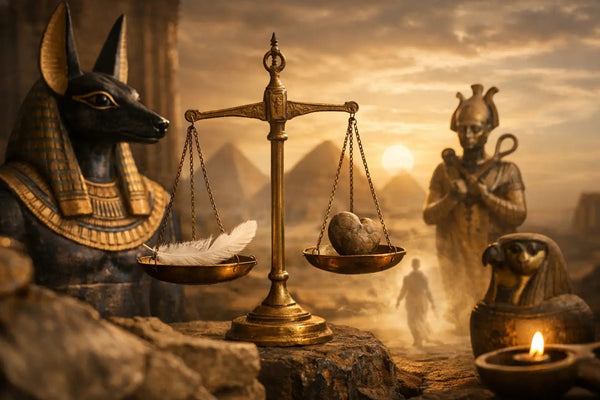
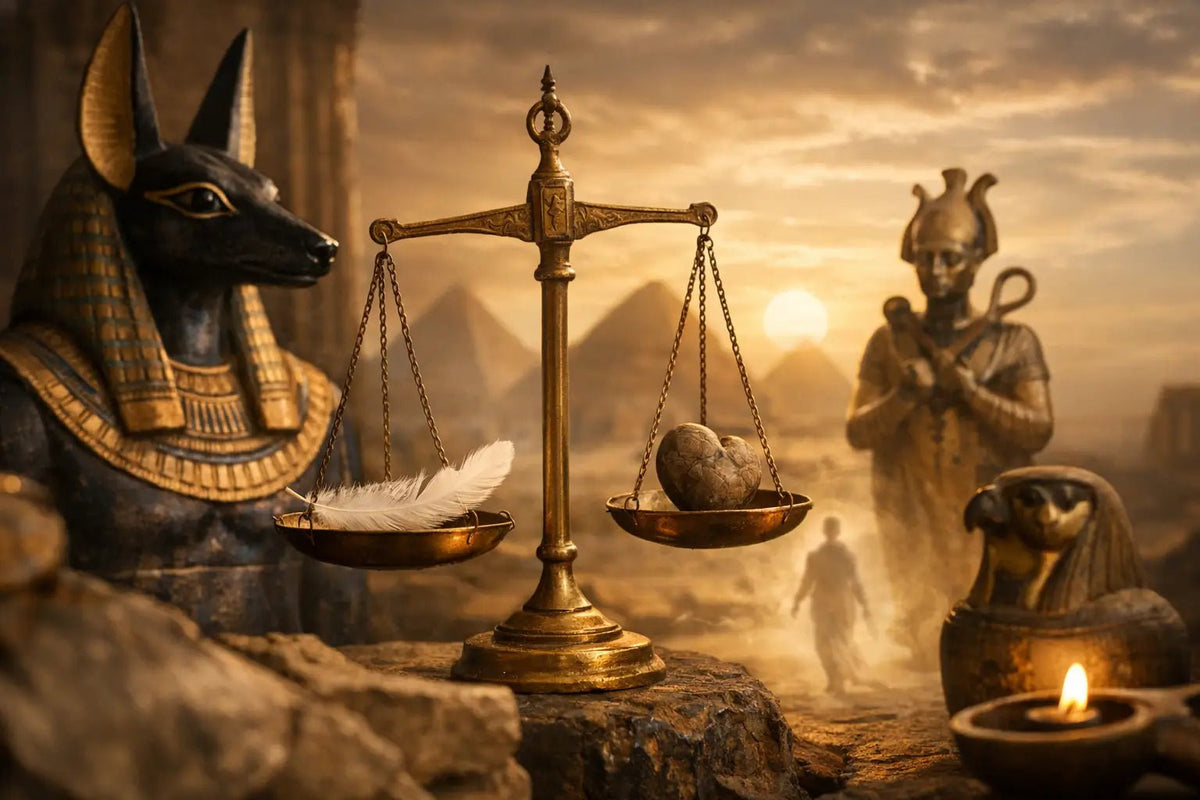
The most enduring image from the Egyptian afterlife is the weighing of the heart. In funerary texts, the deceased enters a hall of judgment and stands before Osiris, lord of the dead. Their heart is weighed against the feather of Ma’at, the principle of truth, justice, balance, and right order.
Ma’at was larger than private morality. It was the order that held the sun in its course, the Nile in its rhythm, society in balance, and human conduct within proper bounds. To live against Ma’at was to participate in disorder. To honor it was to help preserve the world.
The deceased could recite declarations of innocence before a group of divine assessors: claims such as not having stolen, murdered, lied, or abused the vulnerable. These statements are sometimes called the Negative Confessions, though they were not simply a checklist of sins. They presented the dead person as someone fit to live within cosmic order.
If the heart balanced with the feather, the deceased was vindicated. If it failed, it could be consumed by Ammit, a fearsome composite creature with features of a crocodile, lion, and hippopotamus. This was not necessarily eternal torment in the later Christian sense. The deeper terror was annihilation: the loss of continued being, memory, and effective power.
The image carries a stern idea that still lands with force. No title, monument, or outward display could substitute for the weight of one’s heart. The Egyptians built for eternity, but they also understood that character was part of the architecture.
Osiris, Ra, and the Two Paths Beyond Death
There was no single destination after death. Egyptian religion held together two great patterns of renewal.
The first was the realm of Osiris. Murdered by his brother Seth and restored through the devotion and magic of Isis, Osiris became the model for the dead person who is revived after destruction. Through him, the deceased could enter the Field of Reeds, an idealized Egypt of fertile fields, flowing water, harvest, and community. It was not an abstract cloud-world. It was life made secure, productive, and free from scarcity.
The second pattern followed Ra, the sun god. Each night Ra traveled through the underworld, faced chaos, and rose renewed at dawn. Funerary texts allowed the dead to join this solar journey, moving through darkness toward rebirth. The nightly struggle against the serpent Apophis gave cosmic form to a hard truth: renewal is never automatic. Order must be defended against dissolution.
These paths could overlap. A blessed dead person might be united with Osiris, travel with Ra, return as a ba, receive offerings in the tomb, and live among the imperishable stars. Egyptian religion did not always demand a single tidy answer. Its power lies partly in that breadth. Eternity had many chambers.
Texts, Spells, and Sacred Readiness
The famous Book of the Dead was not one fixed book, nor was it originally called that by Egyptians. Its ancient title is often translated as The Book of Going Forth by Day. It was a collection of spells, hymns, instructions, and images designed to help the deceased move safely through the next world.
Earlier elites used Pyramid Texts, carved inside royal pyramids during the Old Kingdom. Later, Coffin Texts brought many afterlife formulas beyond the royal sphere, appearing on coffins used by wealthy nonroyal Egyptians. By the New Kingdom, papyrus copies of the Book of the Dead could be customized for individuals.
These texts were practical in the fullest sacred sense. A spell might help someone remember their name, avoid dangerous beings, pass a gatekeeper, transform into a bird, or ensure that the heart did not testify against its owner. Words had force. To know the proper name, formula, and image was to carry a weapon suited to the terrain ahead.
That does not mean Egyptians believed magic excused a disordered life. Protective texts and moral judgment existed side by side. One needed ritual knowledge, divine favor, social remembrance, and a heart aligned with Ma’at. The afterlife was prepared for through both ceremony and conduct.
What the Egyptian Afterlife Still Asks of Us
The ancient Egyptian encounter with death was disciplined rather than sentimental. It asked a person to preserve what mattered: body, name, bonds of kinship, moral record, and relationship to a larger order. Its tombs were magnificent because the stakes were immense. A life had to be made durable against time.
There is a useful distinction here. The Egyptians did not seek immortality merely as endless duration. They sought continued identity with meaning intact. Their dead ate, worked, remembered, praised the gods, crossed waters, faced trials, and rose again with the sun. Eternity was active.
Read the weighing of the heart not as an invitation to fear death, but as a challenge to live with enough truth that your inner measure can bear examination. Build a name worth speaking. Keep faith with those who depend on you. Defend order where chaos is easier. The old Egyptian question remains direct and demanding: when your heart is placed on the scale, what will it weigh?