Greek versus Norse Mythology: Gods and Fate
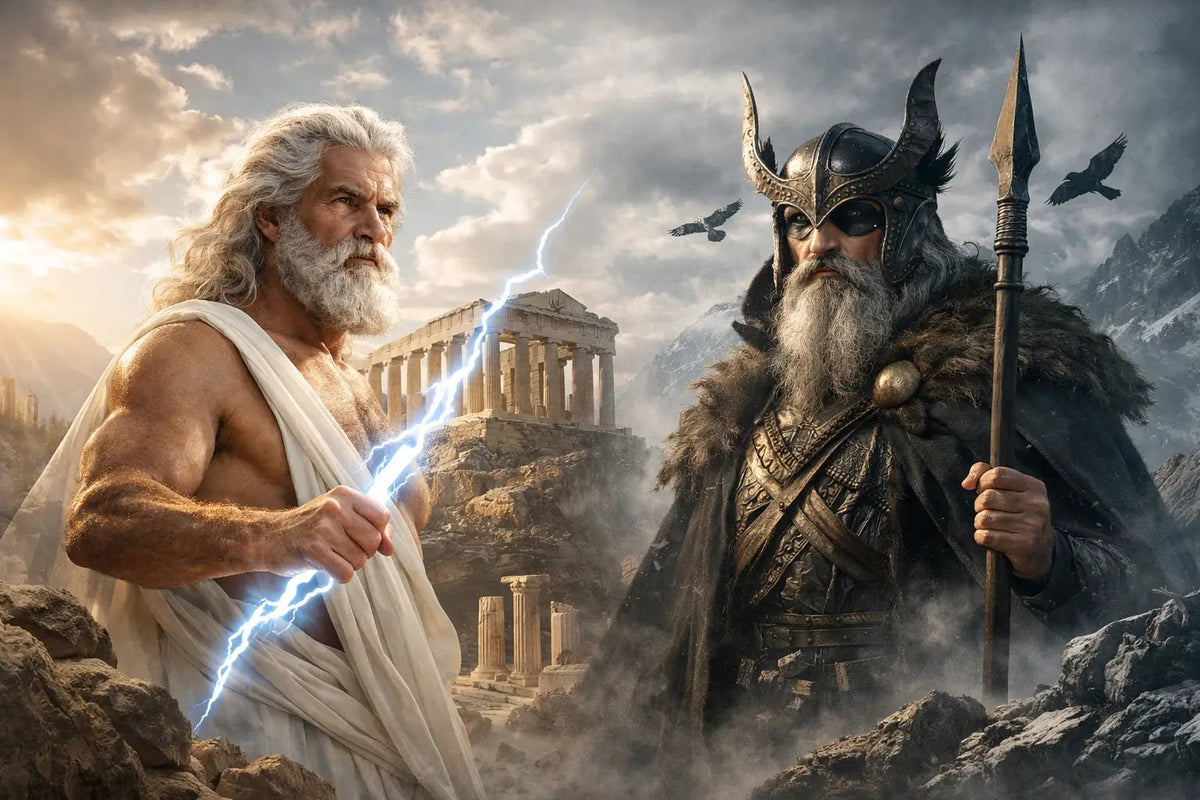
A thunder god lifts his hammer against the forces of ruin. A king of gods hurls lightning from a mountain above the mortal world. At first glance, Greek versus Norse mythology seems like a contest between familiar symbols: Zeus against Odin, Thor against Heracles, Olympus against Asgard. The deeper contrast is more demanding. These traditions offer two distinct answers to an enduring question: how should a person live when strength, loss, and fate cannot be avoided?
Greek myth often examines the cost of human ambition under a brilliant but volatile divine order. Norse myth confronts a colder truth: even the gods are mortal, and courage is measured by how one meets an end already foreseen. Both traditions honor power. They simply ask different things of it.
Greek Versus Norse Mythology at Its Core
Greek mythology grew from the religious and poetic traditions of the ancient Greek world. Its stories survive through works such as Homer’s Iliad and Odyssey, Hesiod’s Theogony, Greek tragedy, hymns, art, and later Roman retellings. There is no single official version of every myth. The tradition changed across centuries and city-states, with local cults and poets shaping the gods in different ways.
Norse mythology comes from pre-Christian Scandinavia and the wider Germanic world. Much of what modern readers know was recorded in medieval Iceland, especially in the Poetic Edda and Snorri Sturluson’s Prose Edda. That distance matters. These texts preserve older oral material, but they were written down after Scandinavia had largely converted to Christianity. Norse myth is powerful and richly textured, but it should not be treated as a perfectly complete transcript of Viking Age belief.
That difference in surviving sources affects the feeling of each world. Greek mythology can seem expansive, theatrical, and psychologically intricate. Norse mythology often arrives in sharper fragments: prophecies, boasts, riddles, feuds, and brief visions of an approaching catastrophe.
The Gods: Immortal Rulers or Doomed Warriors?
The Olympian gods are immortal, though they are far from morally flawless. Zeus, Hera, Athena, Apollo, Artemis, Aphrodite, and Poseidon possess immense authority, yet they are jealous, partisan, sensual, proud, and easily offended. Their immortality does not make them serene. It makes their conflicts larger, longer, and more consequential for mortals caught in their wake.
Greek gods rule a cosmos that has already passed through violence into a guarded order. Zeus defeats the Titans, secures his throne, and establishes a hierarchy. Threats remain, but Olympus endures. The question is usually not whether the divine order will collapse, but what happens when a human being challenges, misunderstands, or is crushed beneath it.
The Norse gods are formidable, but they do not stand outside fate. Odin knows that Fenrir will kill him. Thor knows he will face the world-serpent, Jormungandr. The gods prepare for Ragnarok, the final conflict in which much of their world will burn, drown, and break apart. Their greatness lies not in escaping this knowledge but in acting despite it.
This is one of the clearest distinctions. Greek divinity often represents enduring, dangerous authority. Norse divinity represents resistance under a sentence that cannot be overturned. Zeus reigns. Odin sacrifices.
Fate Means Something Different in Each Tradition
Neither mythology imagines a person as completely free. The Greeks had the Moirai, or Fates, who spun, measured, and cut the thread of life. Even Zeus does not casually erase what has been fated. Yet Greek stories are intensely concerned with choice, especially the choices made through pride, appetite, fear, and poor judgment.
Consider Achilles. He is told that he may live a long, obscure life or die young and win lasting glory. Fate frames the decision, but it does not erase his agency. His wrath, grief, and return to battle reveal a man wrestling with the meaning of the life available to him. Greek tragedy presses this tension further: a person may be bound by prophecy and still bear responsibility for the way he acts.
Norse fate is often more severe in tone. The Norns shape destiny, and prophecy carries enormous weight. Yet fatalism is not passivity. A warrior who knows defeat is possible, or even certain, is still judged by his willingness to stand his ground. This is not optimism. It is resolve.
The distinction matters for modern readers. Greek myth asks whether you can master the flaw that brings ruin. Norse myth asks whether you can remain honorable when ruin is no longer a possibility but a certainty.
Heroism: Excellence, Glory, and Endurance
The Greek ideal of arete means excellence or virtue fulfilled through action. A hero seeks to become fully capable: skilled in battle, persuasive in speech, disciplined in mind, loyal to friends, and memorable in deed. But greatness is never clean. Odysseus survives through intelligence and deception. Heracles performs impossible labors yet is also driven by rage and suffering. Achilles is unmatched in war, but his anger nearly destroys the Greek cause.
Greek heroes often possess exceptional gifts that become their burden. Their lives warn that talent without self-command can turn into catastrophe. Hubris, the arrogant overstepping of mortal limits, is one of the tradition’s great dangers. The world may admire strength, but it does not excuse blindness.
Norse heroism places greater emphasis on reputation, oath, kinship, and steadfastness. The hero is not necessarily expected to win. He is expected to meet danger without surrendering his name. In the Volsunga Saga and related heroic poems, Sigurd earns renown by killing the dragon Fafnir, but the story does not settle into a simple triumph. Wealth, betrayal, and vengeance follow close behind.
For the Norse warrior, honor can outlast the body. That idea can be compelling, but it also carries a cost. A culture centered on reputation can turn disputes into cycles of revenge. Norse stories understand this darkness. Their heroes are not merely fearless. They are often trapped by the very obligations that define them.
Order and Chaos in Two Mythic Worlds
Greek mythology is structured by boundaries: mortal and divine, civilized and wild, guest and host, city and wilderness. Violating these boundaries brings consequences. The myth of Icarus is not only about daring too high. It is about refusing proportion and counsel. The story of Niobe is not simply divine cruelty. It examines what happens when pride turns grief into defiance of the gods.
Norse mythology places more emphasis on a fragile order surrounded by hostile forces. The giants are not merely monsters. They are ancient, necessary, and often entangled with the gods through marriage, kinship, and conflict. The world is held together, but never permanently secured. Even Asgard requires vigilance.
This gives Norse myth its rugged atmosphere. Winter comes. Oaths break. Monsters wait beyond the boundary. The task is not to create a perfect world. It is to protect what is worth protecting for as long as one can.
Why the Myths Still Matter
The temptation is to reduce Greek myth to beauty and intellect, Norse myth to battle and stoicism. Both reductions fail. Greek mythology contains brutal warfare, cosmic terror, and profound endurance. Norse mythology contains wit, poetry, tenderness, hospitality, and a deep reverence for wisdom. Odin is a war god, but he is also a seeker who pays dearly for knowledge.
What each tradition offers is not a costume for borrowed identity, but a set of difficult mirrors. Greek myth challenges the hunger for recognition, pleasure, control, and greatness. It asks where excellence becomes excess. Norse myth challenges the instinct to retreat when the future looks uncertain. It asks whether conviction remains when victory is not guaranteed.
For a life shaped by discipline, these myths work best together. From the Greeks, take the demand for self-knowledge and measured strength. From the Norse, take the refusal to let fear dictate conduct. Neither tradition promises comfort. Both insist that character is formed where pressure meets choice.
The old stories do not ask you to become a god or a saga hero. They ask something more useful: when your own hard season arrives, decide what you will stand for before the storm gives you no time to choose.