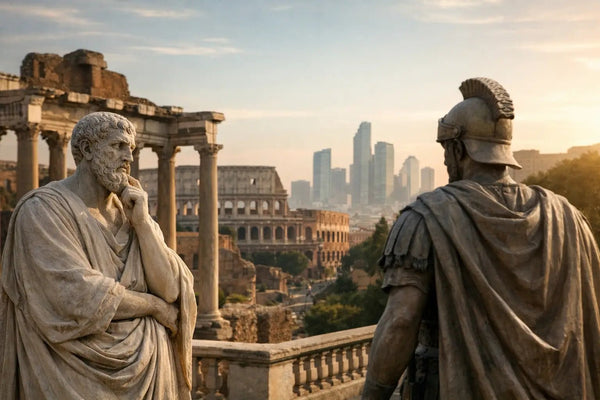
Plato vs Aristotle Ethics: The Good Life
A warrior can train for years and still ask the question that matters most: what is strength for? Is it enough to be skilled, admired, and feared, or must strength serve something higher? The enduring debate of Plato vs Aristotle ethics begins there. Both philosophers believed that a human life should be shaped by virtue, reason, and purpose. But they disagreed sharply about where the good life is found and how a person becomes worthy of it.
Plato directs the eye upward. He asks us to measure our lives against an eternal standard of truth and goodness. Aristotle looks closer to the ground beneath our feet. He asks what a human being does, chooses, practices, and becomes through the ordinary pressures of life.
Their disagreement is not merely academic. It is a choice between two enduring moral instincts: seek an ideal that stands above circumstance, or forge character through disciplined action within it.
Plato vs Aristotle Ethics: Two Visions of the Good
For Plato, ethics begins with a reality greater than personal preference, public opinion, or passing success. The highest object of knowledge is the Form of the Good: the ultimate source by which truth, justice, beauty, and every lesser good become intelligible. In The Republic, Plato compares the Good to the sun. Just as sunlight allows the eye to see visible things, the Good allows the mind to understand what is real and worthy.
This gives Plato's ethics a demanding, almost ascetic character. A good person is not simply someone who follows rules or produces favorable outcomes. He is someone whose soul is ordered correctly. Reason must govern spirit and appetite, much as a wise ruler governs a city. Courage has its place. Desire has its place. But neither should hold the throne.
Plato's central virtue is justice, understood as inner harmony. The just person does not let hunger for pleasure, status, wealth, or revenge command the whole self. He develops the strength to let reason judge what is worth pursuing. A person may appear powerful while living in bondage to appetite. In Plato's view, that is not power. It is civil war within the soul.
Aristotle shares Plato's conviction that ethics concerns the formation of character, not the memorization of commands. Yet he resists the idea that moral wisdom depends on grasping a separate, eternal realm of Forms. The good must be found in human life as it is lived, with its choices, relationships, bodies, obligations, failures, and limits.
His starting point is eudaimonia, often translated as happiness but better understood as flourishing. This is not a pleasant mood or a life of constant comfort. It is the full and excellent activity of a human soul over a complete life. For Aristotle, the good life is not possessed like a trophy. It is enacted.
Plato: Virtue as Order of the Soul
Plato's moral vision has the clarity of a standard raised above the battlefield. It asks whether your actions serve what is truly good, rather than what is immediately rewarding. This is its enduring force. It refuses to let society define virtue by popularity, wealth, or victory.
In Plato's three-part soul, appetite seeks physical satisfaction and material gain. Spirit seeks honor, recognition, and the will to overcome. Reason seeks truth. None of these forces is inherently evil. Appetite keeps us alive; spirit gives us courage and righteous indignation. The danger comes when the lower forces seize command.
The disciplined soul is therefore not a deadened soul. It is a well-governed one. Courage becomes the steadfast defense of what reason knows is right. Temperance becomes agreement within the self that certain desires should not rule. Justice emerges when each part performs its proper work.
This account carries a hard truth for anyone committed to self-mastery: motivation alone is not virtue. A fierce spirit can defend what is noble or become addicted to conflict. Desire can be directed toward love, beauty, and creation, or toward endless consumption. Plato asks each person to establish a ruling principle within. Without one, talent becomes dangerous and freedom becomes drift.
Yet Plato can feel distant from the rough texture of daily moral life. His ideal is luminous, but how does someone recognize the Good when choices are mixed, information is incomplete, and every option carries a cost? Aristotle's answer is that virtue requires trained judgment, not only a vision of perfection.
Aristotle: Virtue as a Practice
Aristotle is often more immediately useful because he treats character as something built through repetition. “We become just by doing just acts,” he argues in Nicomachean Ethics. No one becomes courageous by admiring courage from a safe distance. Courage is formed by facing fear in the right way, for the right reason, at the right time.
This is the heart of Aristotle's ethics: virtue is a habit of choice. It is not a feeling, a slogan, or an inherited identity. A person becomes generous through generous action, truthful through truthful speech, and disciplined through repeated restraint. Character is forged as a blade is forged, through heat, pressure, correction, and use.
Aristotle's famous doctrine of the mean is often misunderstood as a call for bland moderation. It is not. The mean is not always halfway between two extremes. It is the fitting response in a particular situation. Courage, for example, stands between cowardice and rashness. The courageous person does not feel no fear. He neither flees when honor requires action nor charges forward when judgment requires restraint.
This is why Aristotle places such weight on phronesis, practical wisdom. A rule can tell you that honesty matters. Practical wisdom helps you know how to speak honestly without cruelty, when silence is cowardice, and when silence is mercy. It is moral perception sharpened by experience.
Aristotle is also more candid than Plato about the role of circumstance. Flourishing needs virtue, but it also needs some measure of health, friendship, security, and opportunity. A person can remain noble in hardship, yet severe misfortune can damage the conditions required for a fully flourishing life. This is not weakness in Aristotle's system. It is realism. Human beings are not detached souls. We are embodied, social, vulnerable creatures.
Where Their Ethics Clash
The deepest divide is not whether virtue matters. Both men place virtue at the center of life. The divide is whether virtue is primarily alignment with an eternal moral reality or excellence developed through lived practice.
Plato gives moral life a fixed north star. His philosophy is powerful when the crowd is confused, when corruption is rewarded, or when a person needs to remember that success without justice is a form of defeat. He teaches that the soul must answer to something higher than appetite and public approval.
Aristotle gives moral life its training ground. His philosophy is powerful when ideals must become conduct: how to lead well, speak well, endure pressure, manage anger, choose friends, use wealth, and act under uncertainty. He teaches that noble character is not revealed in one grand declaration. It is built across thousands of decisions.
The trade-off is clear. Plato can become too removed from particular circumstances, as if moral truth were easier to see than it is. Aristotle can seem less absolute, leaving more room for disagreement about what the “right” action is in a complicated case. Plato offers moral altitude; Aristotle offers moral traction.
What Their Rivalry Demands of Us
A disciplined life needs both questions. Plato asks: What is worthy of my loyalty? Aristotle asks: What will I repeatedly do today? One protects us from becoming efficient servants of shallow goals. The other protects us from treating noble ideals as decoration.
Consider ambition. Plato would demand that ambition be governed by reason and directed toward justice rather than vanity. Aristotle would ask whether your daily habits make ambition honorable: whether you work steadily, treat rivals fairly, accept correction, and use success without becoming enslaved to it. The first examines the aim. The second examines the practice.
The same is true of courage. Plato reminds us that courage without wisdom can become mere aggression. Aristotle reminds us that wisdom without action can become a comfortable excuse for avoidance. A complete character needs a clear standard and the nerve to live by it.
For those drawn to ancient symbols, this matters. A sword, helmet, or laurel has no moral power by itself. Its value lies in what it calls forth: restraint before violence, endurance under trial, honor in action, and responsibility for the force one carries. Symbols become meaningful when they point beyond appearance toward practiced character.
The good life is not found by choosing between the heights of Plato and the discipline of Aristotle once and for all. Hold an ideal high enough to judge your desires, then build habits strong enough to survive the ordinary day. When the test arrives, let your actions show what rules your soul.