What Does Atlas Represent Mythologically?
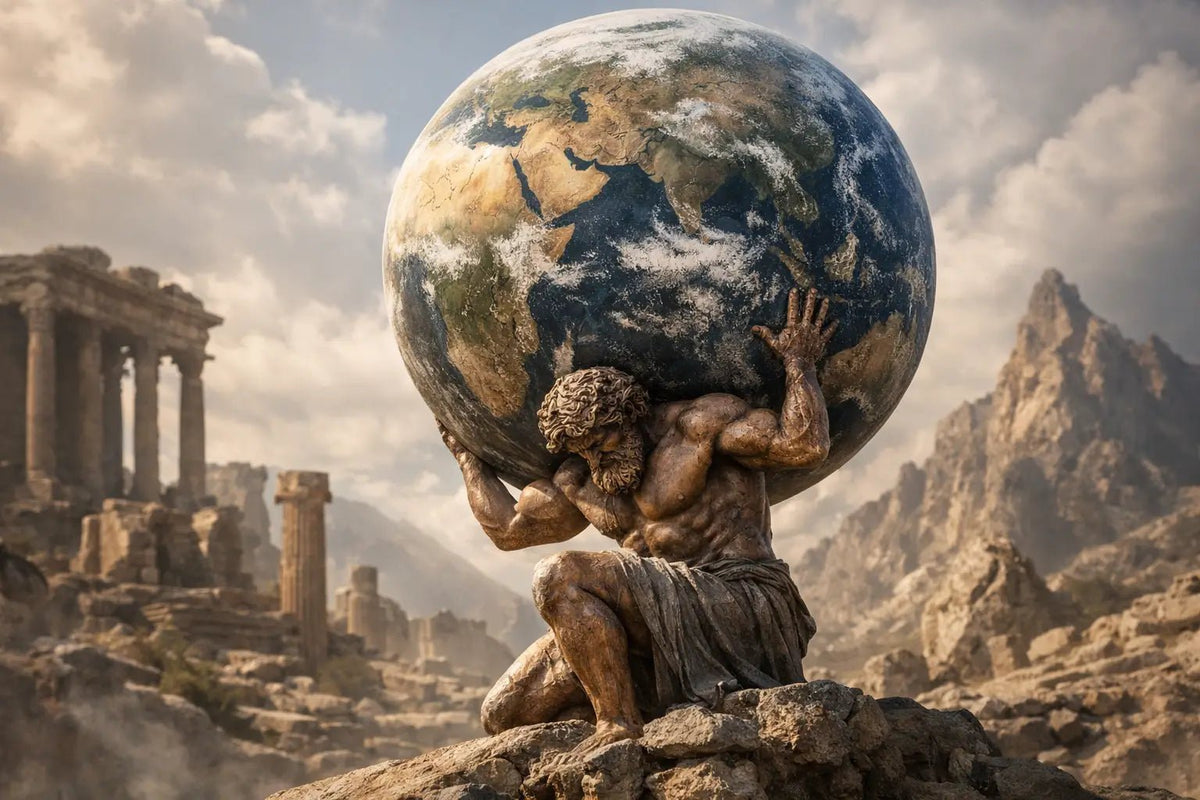
Atlas is often pictured beneath a globe, his back bent under the weight of the world. But what does Atlas represent mythologically? The Greek Titan stands for more than brute endurance. His story holds together punishment, defiance, duty, and the difficult discipline of carrying what cannot be set down.
That is why Atlas has endured as a symbol long after the Olympian gods faded from public worship. He speaks to anyone who has accepted a hard responsibility, resisted collapse, or learned that strength is not always glorious. Sometimes it is simply the decision to remain standing.
Atlas Represents Endurance Under an Immense Burden
In Greek mythology, Atlas was one of the Titans, the older generation of divine powers who ruled before Zeus and the Olympians. He was the son of Iapetus and, depending on the source, either Clymene or Asia. His brothers included Prometheus, Epimetheus, and Menoetius, each linked to a different human and divine tension: foresight, afterthought, reckless force, and resistance to divine order.
During the Titanomachy, the great war between Titans and Olympians, Atlas fought against Zeus. When the Olympians won, Zeus gave Atlas a punishment unlike that of the Titans cast into Tartarus. Atlas was condemned to hold the sky apart from the earth for eternity.
This detail matters. In the oldest traditions, Atlas does not hold up the planet. He supports the heavens, often imagined as the celestial vault or the western pillar of the sky. The task is cosmic. If he fails, the boundary between earth and heaven collapses.
Atlas therefore represents endurance at its most severe. His strength is not measured by a single victory or heroic display. It is measured by duration. He bears the same burden day after day, age after age, without relief.
For modern readers, that image can feel uncomfortably familiar. Responsibility is rarely a dramatic battlefield moment. More often, it is sustained effort: raising a family, keeping a promise, leading through uncertainty, recovering from loss, or doing necessary work when no one is watching. Atlas gives that quiet form of strength a mythic scale.
What Atlas Represents Mythologically Beyond Strength
To reduce Atlas to “strength” misses the sharper edge of the myth. His burden is a sentence imposed after defeat. He is powerful, but he is also bound. He embodies the cost of opposition and the consequences of aligning oneself against a new order.
That does not make Atlas a simple villain. Greek myth is rarely so clean. The Titans are ancient forces, and their conflict with Olympus reflects a recurring pattern in Greek storytelling: one order replaces another, and the defeated powers do not disappear without leaving their mark. Atlas becomes a permanent figure at the edge of the world, holding the structure of reality in place even after losing his war.
There is a paradox in that role. The rebel against Zeus becomes essential to Zeus's cosmos. His punishment is also a duty. He is defeated, yet indispensable.
This is one reason Atlas resonates as a symbol of disciplined resilience. He does not represent freedom from burden. He represents the capacity to meet burden without surrendering one's stature. His posture is difficult, but it is not small.
Still, the myth should not be used to romanticize exhaustion. Atlas is not an ideal because he carries everything alone. His condition is tragic precisely because it has no end. The deeper lesson is not that every person should accept limitless weight. It is that a burden must be understood clearly before it is carried. Duty without limits can become punishment. Endurance without purpose can become self-erasure.
The Pillar Between Heaven and Earth
Atlas also represents cosmic order. In early Greek imagination, the world required boundaries: sea from land, mortal from divine, earth from sky. Atlas stands at the far western edge of the known world, where sunset seemed to mark the threshold of mystery.
In Homer's Odyssey, Atlas is described as knowing the depths of the sea and holding the tall pillars that keep heaven and earth apart. This is not merely a feat of physical might. It is a stabilizing role. Atlas preserves separation, balance, and structure.
That makes him a fitting emblem for people who value order in their own lives. Discipline is not the absence of chaos. It is the practice of placing boundaries where they are needed. A person who keeps faith with a standard, guards their time, trains their body, or refuses to betray a principle performs a smaller but recognizable version of Atlas's work. They hold a line.
The symbolism has limits, of course. Atlas bears his burden by divine compulsion, while human discipline has moral value only when chosen with awareness. Yet the image remains powerful because it recognizes a hard truth: stability is maintained. It does not arrive by accident.
Atlas, Heracles, and the Burden Shared
The most revealing Atlas story appears in the labors of Heracles. Sent to retrieve the golden apples of the Hesperides, Heracles seeks Atlas because the Hesperides are Atlas's daughters. Atlas agrees to fetch the apples if Heracles will take up the sky in his place.
Heracles accepts. For a brief time, Atlas is free.
Then Atlas returns with the apples and suggests that he can deliver them himself, leaving Heracles to bear the heavens permanently. Heracles answers with a strategy rather than raw force. He agrees, but asks Atlas to hold the sky for one moment while he adjusts his cloak for the weight. Atlas takes the burden back, and Heracles leaves with the apples.
The episode complicates Atlas's image. He is not only a suffering giant. Given an opportunity, he tries to pass on the burden that has defined him. Heracles, meanwhile, demonstrates that strength requires judgment. He does not win by carrying more indefinitely. He wins by recognizing the trap and acting with composure.
This is the trade-off within the Atlas symbol. Carrying weight can build character, but wisdom includes knowing when a burden is yours, when it is temporary, and when someone is trying to make it permanent. Courage is not mindless load-bearing. It is responsibility joined to discernment.
Why Atlas Is Shown Carrying the World
The familiar image of Atlas carrying a globe is a later development. Ancient Greek accounts generally describe him carrying the sky, not the earth. Over centuries, artists began to portray him holding a sphere. In many cases, that sphere represented the celestial heavens, marked with constellations, rather than the globe itself.
The famous Farnese Atlas, a Roman sculpture based on an earlier Greek model, shows Atlas supporting a celestial sphere. Later viewers increasingly read the sphere as the world. That visual shorthand became so widespread that “carrying the world on your shoulders” is now inseparable from Atlas in popular culture.
The modern image is not wholly wrong. It captures the emotional truth of the myth even if it blurs its original cosmology. Atlas has become the figure of overwhelming responsibility: the leader holding together a failing institution, the parent carrying a household, the individual who feels the consequences of every decision.
But the sky is symbolically richer than a globe. To hold the heavens is to maintain the conditions under which everything below can continue. Atlas does not possess the world. He bears the framework around it.
Atlas as a Symbol of Resistance and Consequence
Atlas is sometimes treated as a straightforward emblem of heroic rebellion. There is truth in that reading. He fought the reigning power and paid a terrible price. His story can speak to the resolve required to stand against forces greater than oneself.
Yet mythology does not flatter resistance simply because it is resistance. Atlas's rebellion fails, and the punishment is absolute. The myth asks a harder question: what is worth opposing, and what are you prepared to carry if you do?
That question gives Atlas his enduring gravity. He represents the consequences of conviction. A person may choose a demanding path, defend an unpopular principle, or take responsibility where others retreat. Such choices can bring purpose, but they also bring weight. Myth does not promise that the strong will be spared. It asks whether they can remain faithful to what they have chosen.
Atlas endures because he is not a symbol of easy triumph. He is the image of a person under pressure who refuses to collapse. Let that be the useful part of his legacy: choose your burden with clear eyes, build the strength to bear it, and remember that true discipline includes knowing what should never rest on one set of shoulders alone.