A good yin yang graphic shirt does not succeed because the symbol looks balanced. It succeeds because the symbol carries weight. Long before it appeared on streetwear, posters, and trend cycles, yin and yang named a way of seeing the world - one that treats opposites not as enemies, but as forces that define and refine each other.
That is why this motif has endured. The best versions do more than decorate a garment. They translate an old philosophical idea into something visible, personal, and wearable. The worst versions flatten it into a vague sign for peace, mystery, or aesthetic contrast. The difference matters, especially if you care about symbolism and not just surface.
What the yin yang graphic shirt actually represents
The yin yang symbol, often called the taijitu, comes out of Chinese philosophical tradition. It expresses a simple truth with difficult implications: reality is shaped by complementary forces. Yin is often associated with darkness, receptivity, stillness, depth, coolness, and the inward. Yang is associated with light, action, heat, assertion, motion, and the outward. Neither is superior. Neither exists in pure isolation.
That last point is what gives the symbol its force. Each half contains a seed of the other. The dark field holds a point of light. The light field holds a point of dark. This is not decorative symmetry. It is a statement about life itself. Strength becomes ruin without restraint. Rest becomes stagnation without movement. Order hardens if it never yields. Change becomes chaos if it never takes form.
A shirt bearing this symbol can therefore say something more serious than most graphic apparel. It can mark an allegiance to balance, but not the shallow kind. Not a life without tension. A life disciplined enough to carry tension well.
Why the symbol keeps returning
Some graphics rise and vanish with the season. Others return because they express an enduring pattern. The yin yang belongs to the second category.
It survives because people continue to recognize themselves in it. The athlete understands exertion and recovery. The leader learns decisiveness and patience. The artist works through structure and improvisation. The philosopher wrestles with permanence and change. Even the most modern life is still shaped by ancient dualities - silence and noise, ambition and restraint, solitude and duty.
This is where a yin yang graphic shirt becomes more than a casual style choice. It can serve as a compact philosophy worn close to the body. For some, that may sound too weighty for apparel. Fair enough. Not every garment needs to carry a worldview. But symbolic clothing has always existed for this reason. Humans have long used what they wear to signal values, tribe, rank, memory, and aspiration.
The question is not whether a shirt can mean something. The question is whether the design earns that meaning.
The difference between thoughtful design and empty symbolism
A symbol this well known is easy to misuse. Once a motif becomes popular, designers often treat it as visual shorthand instead of philosophical language. That is when the yin yang starts losing its edge.
Thoughtful design begins with proportion, clarity, and restraint. The symbol should remain recognizable and intact unless there is a deliberate reason to reinterpret it. Distortion for the sake of novelty usually weakens it. So does overcrowding it with unrelated iconography that competes for attention.
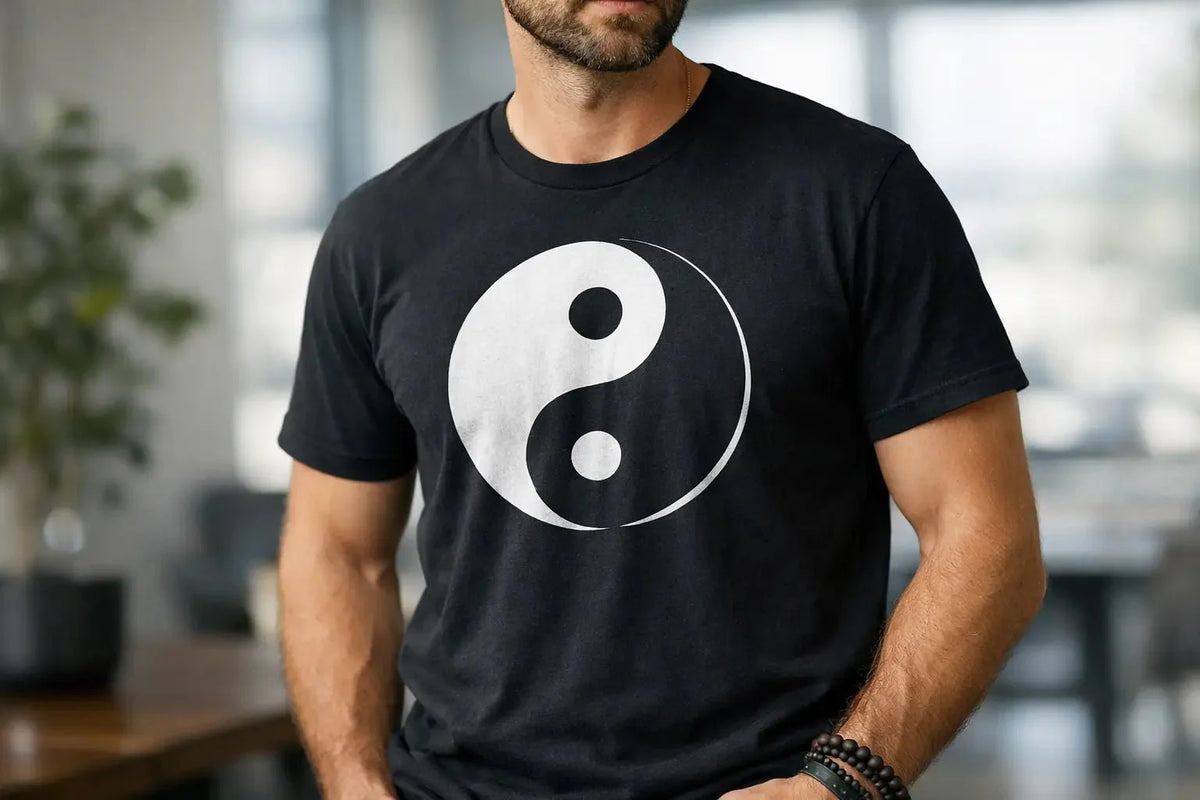
Material and print execution matter too. A profound symbol printed poorly feels disposable. Heavyweight fabric, clean line work, and considered placement give the design the seriousness it deserves. A centered chest graphic reads differently from a small emblem over the heart. One is declarative. The other is more private, almost meditative. Neither is automatically better. It depends on the wearer and the intention.
Color changes the message as well. Black and white remains the most direct expression of the symbol’s logic. Muted neutrals can make it feel more timeless. Highly saturated palettes can work, but only if the design still preserves contrast and coherence. Once the visual language gets too loud, the philosophy starts to disappear.
Wearing a yin yang graphic shirt without reducing it to a cliché
There is a reason some people hesitate around famous symbols. Familiarity can make them feel overused. That hesitation is reasonable. When a symbol appears everywhere, it can lose precision.
The way through that problem is not to avoid the symbol entirely. It is to wear it with intention. A yin yang graphic shirt works best when the rest of the look does not fight for attention. Clean lines, grounded colors, and durable pieces tend to suit it. The symbol already carries complexity. It does not need costume styling around it.
More importantly, the wearer should have at least some relationship to what it means. You do not need a lecture on classical Chinese thought before putting on a shirt. But if the symbol appeals to you because it names something true about discipline, conflict, or inner balance, that connection changes how the garment reads. It becomes less like borrowed imagery and more like chosen language.
This is where premium symbolic apparel has an advantage. A well-made shirt invites repeat wear, and repeat wear deepens attachment. Over time, the piece becomes part of your rhythm rather than a novelty item pulled out for effect.
What to look for in a better yin yang graphic shirt
If the symbol matters, selection should be more demanding than impulse shopping. Start with construction. The shirt should feel substantial, hold its shape, and age well. A timeless symbol on flimsy fabric creates a contradiction.
Then look at the graphic itself. Is it clean? Is it proportionate? Does the design respect the original form, or has it been altered into something generic? Reinterpretation is not always bad. In fact, a strong designer can use texture, line, historical references, or surrounding motifs to add depth. But the reinterpretation should reveal understanding, not just a need to appear different.
Brand ethos matters too. A label rooted in symbolism, history, and meaning will usually handle this emblem with more care than a trend-driven operation using it as visual filler. That does not guarantee quality, but it often shows in the details. Hilt & Stone, for example, approaches symbolic apparel from the standpoint of enduring ideas rather than passing hype. That difference shapes the final piece.
Fit also matters more than people admit. A symbol this centered on harmony should not sit awkwardly on the body. Some wearers prefer a structured cut that feels disciplined and sharp. Others prefer a looser silhouette that feels easier and more lived-in. Neither choice is philosophically wrong. It is a matter of expression.
The philosophical appeal of wearing opposites
There is a deeper reason this symbol continues to belong on clothing. It speaks to self-mastery.
Most people begin by thinking balance means the removal of contradiction. Age tends to teach the opposite. Real balance is not purity. It is integration. Courage without reflection becomes recklessness. Reflection without courage becomes paralysis. A meaningful life requires contact with both halves.
That is why the yin yang remains relevant to anyone interested in growth. It resists simplistic moral sorting. It does not divide reality into heroes and villains, light and dark, worthy and unworthy in the crude sense. Instead, it asks for awareness, measure, and adjustment. It assumes that life moves in cycles, that extremes turn into their opposite, and that wisdom lies partly in recognizing the moment when force should yield.
Wearing that symbol can be a reminder of discipline with softness, strength with humility, ambition with inward order. Not perfection. Alignment.
A graphic shirt will not give you any of those qualities. It is still just a shirt. But the symbols we choose are rarely trivial. They reveal what patterns we trust, what stories we carry, and what standards we return to when life becomes noisy.
The best clothing does not shout identity. It clarifies it. If a yin yang graphic shirt still resonates, it is because the world keeps proving the same old truth: every durable life is built not by choosing one side forever, but by learning when to stand firm and when to yield.